
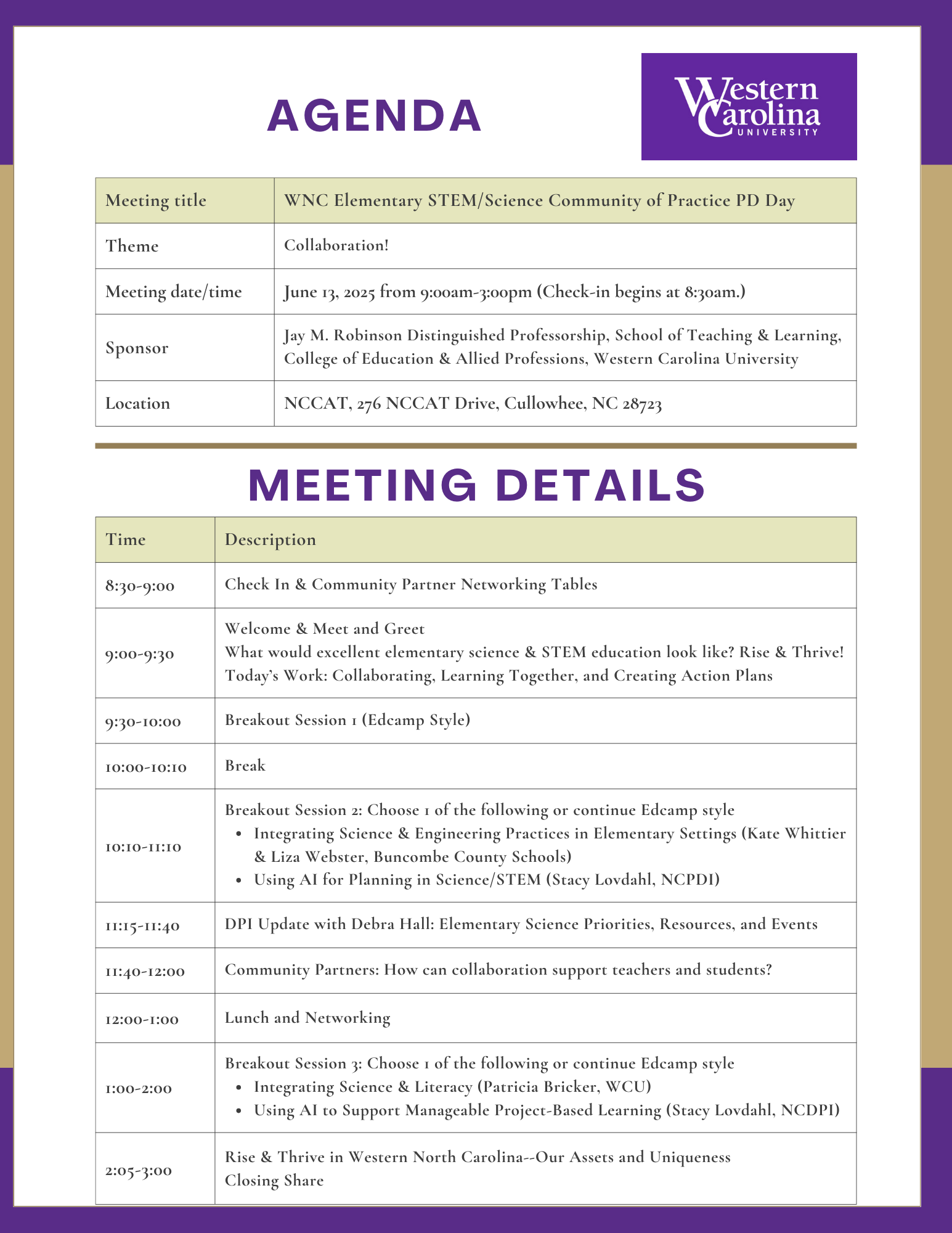
Last Call! Register now for the WNC Elementary STEM/Science Community of Practice Professional Development Day on Friday, June 13, 2025 from 9am-3pm in Cullowhee, NC. Registration closes on May 29.
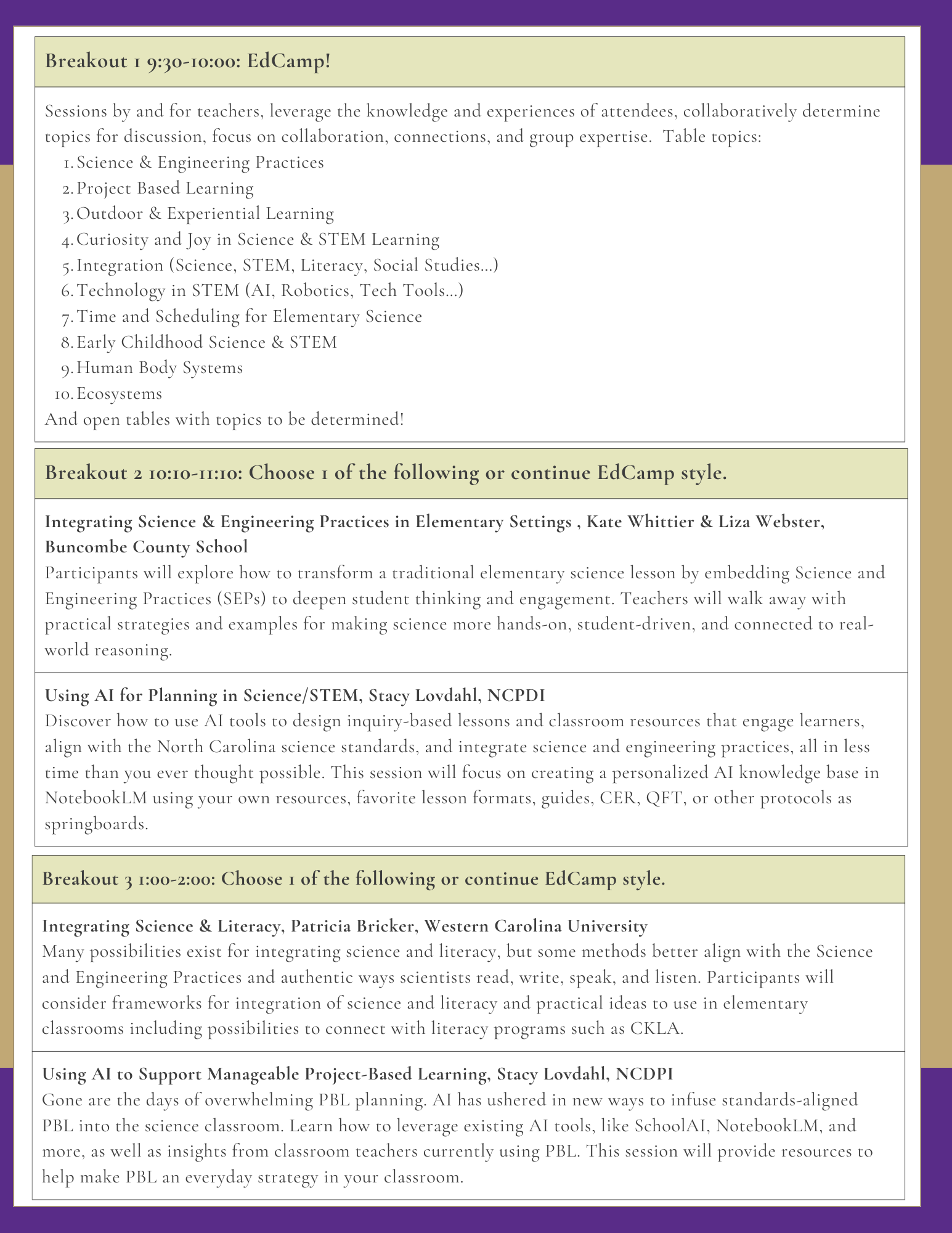
This event is open to all teachers, coaches, school leaders, professional development providers, and community partners interested in elementary science and STEM education in Western North Carolina. It is a continuation of the Community of Practice initiative that began in January 2024 and will focus on connecting, collaborating, and sharing innovative teaching practices. This year’s theme is collaboration and the event is designed so participants will leave with an action plan to guide efforts as they begin the 2025-2026 academic year. The day is sponsored by the Western Carolina University Jay M. Robinson Distinguished Professorship within the School of Teaching and Learning and College of Education and Allied Professions. There is no charge. In addition to EdCamp style breakout sessions, there will be breakouts focused on:
- Integrating Science & Engineering Practices in Elementary Settings (Kate Whittier & Liza Webster, Buncombe County Schools)
- Using AI for Planning in Science/STEM (Stacy Lovdahl, NCPDI)
- Integrating Science & Literacy (Patricia Bricker, WCU)
- Using AI to Support Manageable Project-Based Learning (Stacy Lovdahl, NCDPI)
Click here to register or use this link https://wcu.az1.qualtrics.com/jfe/form/SV_78HZtt7w5nyRwJU
Note: Registration is limited to 80 people. Please spread the word!
Recent Comments