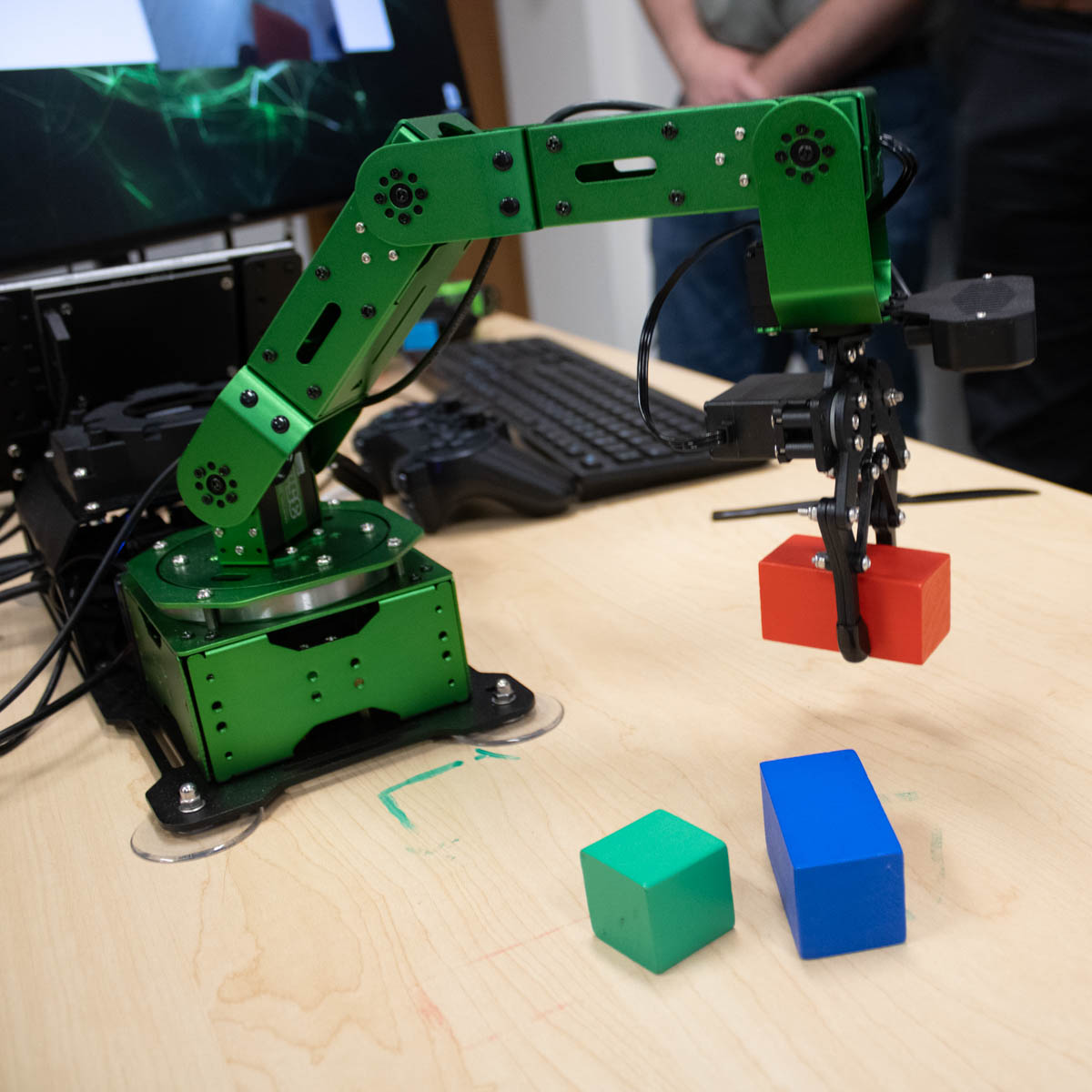
Walk into a Computer Cyber-Physical Systems Lab and you might see a robotic arm plucking a single red block off a moving conveyor belt while ignoring every other color around it. It may look like a party trick. It isn’t. That small, precise motion is a preview of something much bigger: a future where Western North Carolina’s factories can teach their own machines to see, decide, and improve—without ever handing over their most sensitive data.
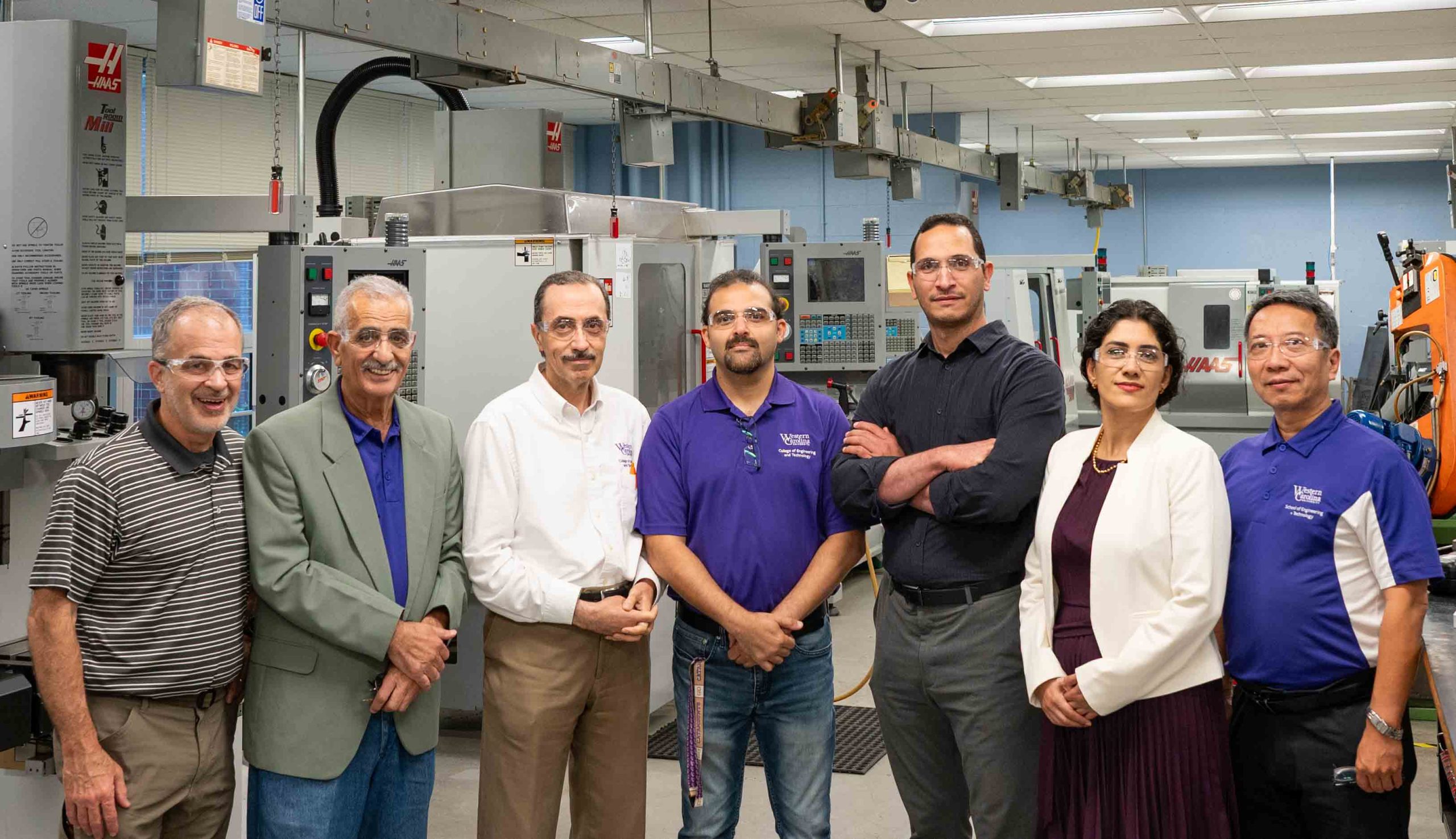
This fall, that vision got a serious boost. WCU has earned its first-ever Research Opportunities Initiative (ROI) grant from the UNC System: $1.5 million over three years, at $500,000 per year, to bring practical artificial intelligence to the manufacturers who power our region’s economy. And while the project is led by Dr. Abdallah Abdallah, its real strength is a faculty team that brings together expertise from five engineering disciplines. WCU serves as the lead institution, with Dr. Abdallah—associate professor in the College of Engineering and a certified NVIDIA Deep Learning Institute instructor—as principal investigator, and a North Carolina State University team led by Dr. Ismail Guvenc contributing nationally recognized expertise in wireless communications under a sub-award.
AI is everywhere in the manufacturing headlines. On the factory floor, the reality is messier. For small and midsized manufacturers in Western North Carolina who know AI could help them, there are questions. Where do we start? What happens to our proprietary data? Will any of this actually pay off?
Those questions aren’t signs of hesitation; they’re signs of good judgment. A single production line can generate millions of sensor readings a week, and that data can be a company’s most guarded asset. Ask a manufacturer to upload their data to someone else’s cloud to train a model, and the conversation ends fast. This project is built around a different answer.
Federated learning: train together, share nothing
The technical heart of the project is a Federated Learning Framework—and it flips the usual AI recipe on its head. Instead of pooling everyone’s data in one place to train a model, federated learning sends the model out to each factory, trains it locally on data that never leaves the building, and then merges only the resulting model updates—not the raw data—into a shared, smarter global model.
That privacy guarantee has to hold up against determined adversaries, which is where co-investigator Dr. Islam Elgarhy comes in. His research spans federated learning, privacy-preserving methods, and cybersecurity, and he co-leads the design of the framework’s algorithms—hardening them so that even the shared model updates can’t be reverse-engineered to leak a company’s secrets. For an industry where competitors may sit two exits apart on the same interstate, that assurance is the difference between “no thanks” and “let’s try it.” Think of it as a hive mind for factories—the machines get collectively smarter while every plant keeps its secrets sealed in its own vault.
Building a machine’s digital twin—and the physics inside it
To make that framework trustworthy before it ever touches a live line, the team is building high-fidelity digital twins—virtual replicas of a partner’s actual machines. A digital twin lets researchers stress-test AI models against a faithful simulation of real equipment, tune them safely, and only then deploy to the physical floor. It shortens the distance between a promising idea and a production-ready tool, and it dramatically lowers the risk of disrupting a running operation.
Getting a twin to behave like the real thing takes more than software—it takes deep knowledge of the physics inside each machine, and this is where the breadth of the WCU team shows. Dr. Bora Karayaka, a professor and IEEE Senior Member specializing in control systems and energy modeling, guides how the twins capture real-time control and energy-aware optimization. Dr. Mona Torabi, whose expertise is in advanced materials mechanics and multi-physics characterization, links a machine’s process settings to how the material itself actually behaves under stress. And Dr. Basel Alsayyed—a licensed Professional Engineer and Certified Manufacturing Engineer with more than a decade in the U.S. automotive industry—anchors the manufacturing-process modeling and leads the team’s push to identify patentable innovations along the way.
Machines that flag their own problems
Quality control is the obvious win—catching a defective part before it ships. But the more transformative application may be predictive maintenance. Sensing subsystems continuously track signals like vibration, temperature, and pressure; AI models learn each machine’s healthy “fingerprint”; and when the data starts drifting, the system flags a likely failure before the machine breaks down. Instead of unplanned downtime that halts a line, a plant gets a scheduled, planned repair—often the single largest cost savings AI can deliver in manufacturing.
It started with HULK, MEDUSA, and OPTIMUS
None of this appeared out of nowhere. It grew out of ENGR 493, the “AI and Computer Vision for Smart Manufacturing” course, where student teams built three robots they named HULK, MEDUSA, and OPTIMUS. MEDUSA trained two robots to cooperate in spotting and removing a target item from a conveyor—an automated defect-removal line in miniature. HULK used a machine-learning classifier to read visual cues and reposition the right colored block. OPTIMUS, a camera-equipped mobile robot, learned to detect, track, and retrieve a moving ball. Funded by a $35,000 UNC System Undergraduate Research Program Award, that course proved the concept and lit the fuse.
The ROI grant takes those same ideas out of the classroom and into real factories—with real datasets, real constraints, and real stakes.
Five disciplines, one team
What makes this team unusual is how deliberately interdisciplinary it is. Rather than a cluster of specialists in one narrow area, it pairs AI and cybersecurity (Dr. Abdallah and Dr. Elgarhy) with control and energy systems (Dr. Karayaka), advanced materials and mechanics (Dr. Torabi), and hands-on manufacturing and industrial engineering (Dr. Alsayyed).
That range matters beyond the research itself. Drs. Karayaka, Torabi, and Alsayyed jointly lead the project’s curriculum development and training workshops, translating the work into courses and hands-on experiences for students. And the grant funds a full talent pipeline: two postdoctoral researchers building the AI models, federated learning implementations, and digital twins, alongside graduate students, undergraduate summer projects, and capstone teams—each shaped by the real requirements of industry partners so students solve the problems manufacturers are actually facing.
Real partners, real production floors
Several regional companies have signed on as non-paid collaborators, each bringing a different slice of the manufacturing world. Southern Container Inc.—which produces more than 35% of the plastic bottle forms for Coca-Cola in North America—will share production datasets and deep injection-molding expertise. Rhino Federated Computing contributes a free license to its federated learning software, putting a state-of-the-art platform in students’ hands. And Lander Tubular Products of Franklin, NC, offers datasets and a site to pilot federated learning nodes in a working environment.
Recognized beyond the region
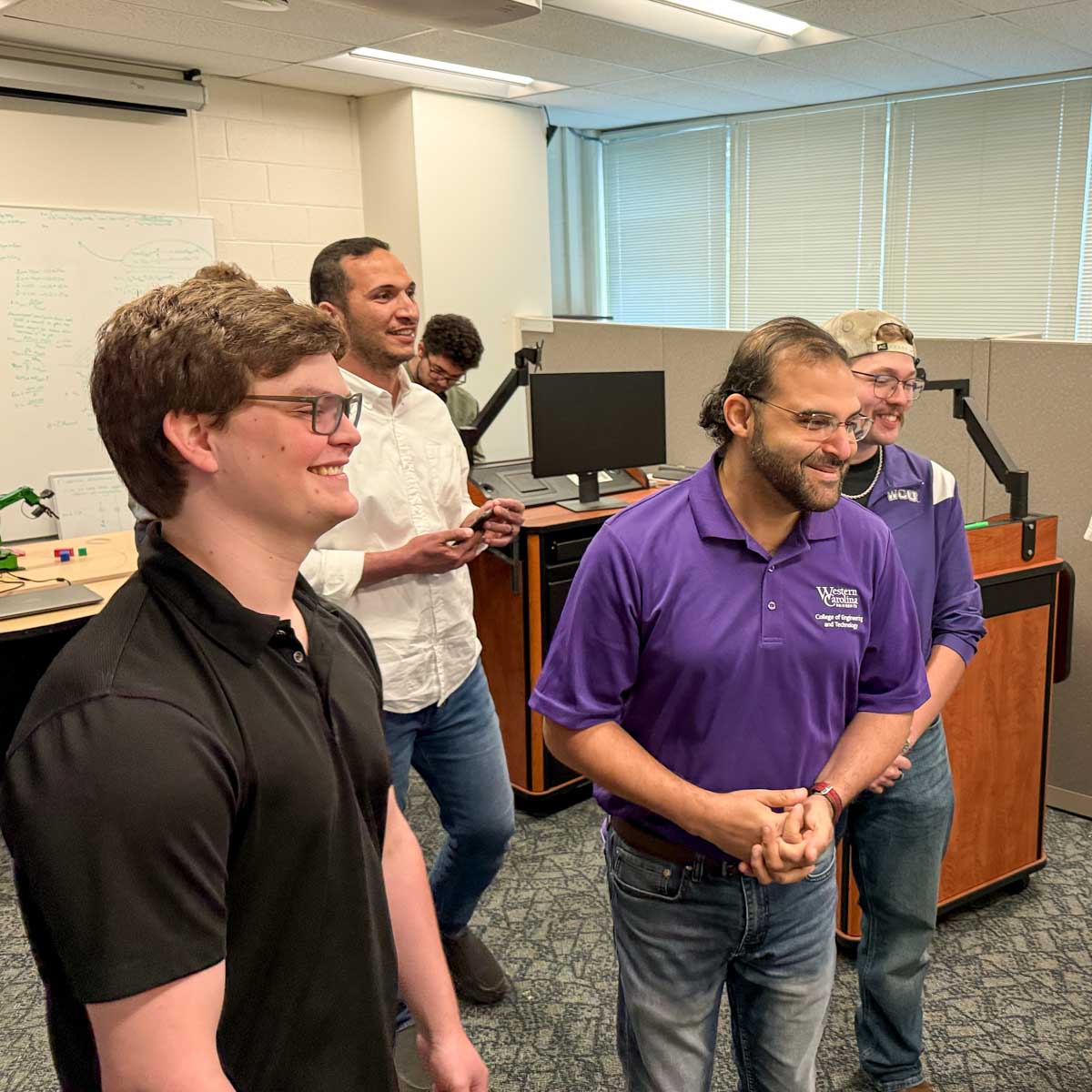
The work is already drawing national attention. The Society of Manufacturing Engineers (SME), a supporter of the project since its inception, selected Dr. Abdallah to serve as a volunteer advisor for its new AI and Digital Manufacturing Technical Community. Its inaugural meeting will be held alongside FABTECH 2026, October 21–23, 2026, at the Las Vegas Convention Center—putting WCU’s work in the same room as the industry shaping AI’s future in manufacturing.
“My goal is for WCU to become the hub regional manufacturers call when they need help integrating AI into their processes but aren’t sure where to begin. They want qualified, trusted partners to walk that path with them.”
The bigger picture
What started as students coaxing robots to sort colored blocks has become a university-wide research venture—uniting undergraduates, graduate students, postdocs, and a faculty team spanning five disciplines, all working with industry toward one mission. If it works the way Dr. Abdallah and his colleagues envision, WCU won’t just be studying the future of smart manufacturing. It’ll be the first call Western North Carolina’s manufacturers make when they’re ready to build it. The future of manufacturing, it turns out, may be assembled right here in Cullowhee—no flying cars required, though the team isn’t ruling anything out.
RELATED LINKS
- WCU College of Engineering
- Inside ENGR 493’s AI + Robotics Projects
- WCU Bachelor of Science in Electrical Engineering
- WCU Bachelor of Science in Electrical and Computer Engineering Technology
- WCU Bachelor of Science in Engineering
- WCU Bachelor of Science in Engineering Technology
- WCU Bachelor of Science in Mechanical Engineering